








By Scott Patchan
- Larger power cables, high-count fiber, complex cooling systems, and limited space are creating more demanding electrical infrastructure.
- Lightweight materials, prefabrication, BIM/Revit models, and efficient joining methods can help contractors address complex installations, tight schedules, and skilled labor constraints.
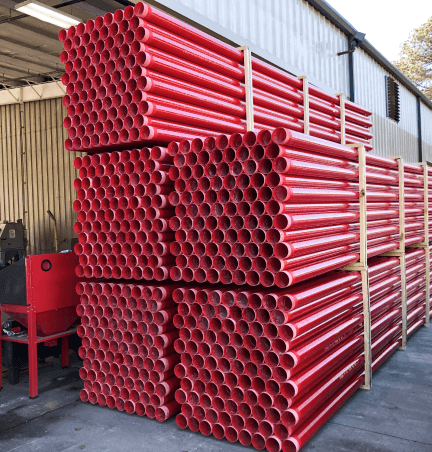
- Champion Duct® combines light weight, a low coefficient of friction, corrosion resistance, no burn-through elbows, and cable fault resistance to address challenges throughout the life of the conduit system.
AI is accelerating an already significant expansion in data center infrastructure. McKinsey estimates that global demand for data center capacity could increase 19% to 22% annually from 2023 to 2030. Next-generation workloads will demand greater power requirements and advanced cooling solutions.
These trends were the focus of a recent Champion Fiberglass webinar presented in partnership with Electrical Contractor Magazine. Matt Fredericks, Vice President of Sales and Marketing at Champion Fiberglass, examined current data center construction trends, contractor installation methods, and the role conduit selection can play in project success.
As data center electrical infrastructure evolves, conduit specifications deserve a close look.
Higher Power Density is Changing Conduit Requirements
High-density fiber-optic cabling is required to move enormous volumes of data in and out of facilities, while larger power cables support increasing electrical demand. Champion Fiberglass is seeing greater demand for 8- and 10-inch conduit than at any previous point in the company’s history, driven in part by data center and industrial power requirements.
Meanwhile, new cooling technologies and extensive mechanical, electrical, and plumbing systems are competing for limited space.
Planning conduit routes, sizing for future capacity, and coordinating with mechanical and plumbing infrastructure have become increasingly important. BIM/Revit models can help identify potential conflicts before installation, while running spare conduit in underground duct banks can provide pathways for future expansion.
Contractors are Rethinking How Data Center Conduit Gets Installed
Data center growth is occurring alongside a shortage of skilled labor, making installation efficiency a major project consideration.
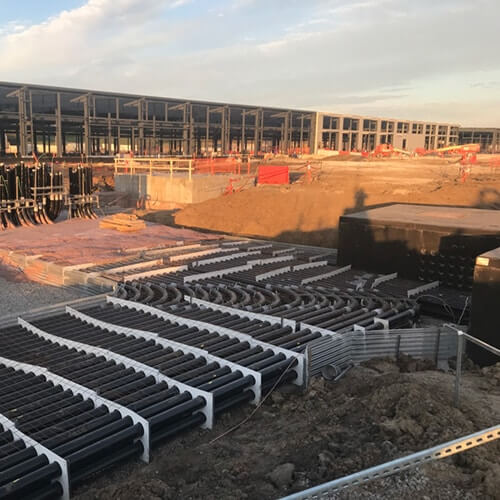
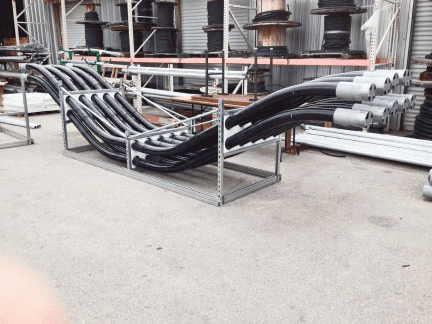
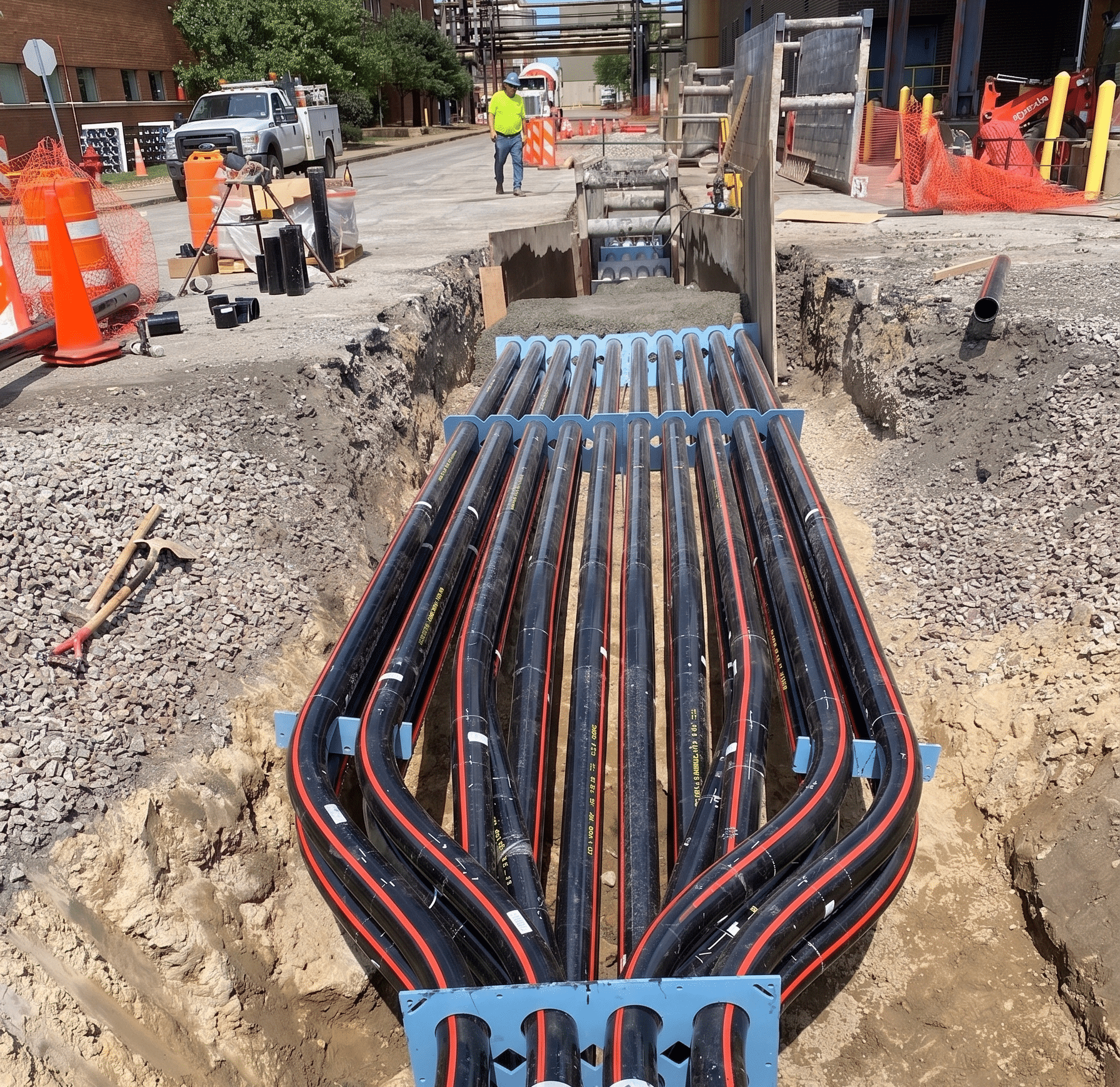
Contractors are increasingly using prefabrication to shift work from the jobsite into controlled environments. Prefabricated duct banks and riser assemblies can be built before delivery, while modular electrical rooms and control-panel huts can arrive at the data center ready for placement.
The low weight of fiberglass conduit supports this approach. It can simplify handling of straight sections, electrical conduit elbows, and prefabricated duct bank assemblies.
Champion Duct also offers a gasket joining system for underground installations that does not require adhesive while providing a tight connection.
Proper installation practices remain essential regardless of conduit material. Manufacturer-recommended bending and cutting procedures, proper cable pulling techniques, PPE, trench shoring, and other underground safety practices should be part of project planning.
Data Center Conduit Selection Requires a Broader View
PVC, GRC, PVC-coated rigid steel, HDPE, and fiberglass may all be considered for data center construction depending on the application.
- GRC may be used in areas of heavy soil compaction.
- PVC-coated steel is appropriate in areas of heavy soil compaction where the risk of corrosion is also present.
- Schedule 40 and Schedule 80 PVC and HDPE can be used for short and long underground distribution.
- Fiberglass conduit is appropriate for everyday long runs due to its low coefficient of friction, in areas of heavy soil compaction, and in corrosive areas because it is nonmetallic.
The appropriate material should be selected based on the complete application, including soil conditions, conduit routing, cable size, compaction, physical damage requirements, thermal conditions, applicable codes, and future capacity.
Electrical Conduit Elbows Can Become a Critical Point in Cable Pulls
Elbows are among the highest-stress points in a conduit run.
As cable moves through a bend, pulling tension and sidewall pressure increase. With PVC electrical conduit elbows, the pulling medium can eventually cut through the inside edge of the elbow (commonly referred to as “burn-through”).
The consequences can extend beyond a damaged elbow. If PVC conduit is encased in concrete, accessing and replacing an elbow may require removing concrete and addressing potential cable damage.
Champion Fiberglass no burn-through elbows reduce this PVC failure mode during cable pulling.
Fiberglass also has a coefficient of friction of 0.38 with PVC-jacketed cable, compared with 0.55 for GRC and PVC-coated steel and 0.90 for Schedule 40 and Schedule 80 PVC. Lower friction can help reduce pulling tension on demanding cable installations.
Learn more about Champion Fiberglass electrical conduit elbows, including options for demanding underground cable pulls.
Cable Fault Resistance Supports Long-Term Serviceability in Data Centers
Conduit selection can also affect what happens years after construction is complete.
Under some cable fault conditions, cable can melt or fuse to PVC conduit. In metallic conduit, faulted cable can weld to the inside of the conduit. Removing and replacing the cable can then require conduit replacement.
With fiberglass, faulted cable does not melt or weld to the inside of the conduit. The damaged cable can be pulled out and replaced without damaging the conduit.
For critical data center electrical infrastructure, cable fault resistance provides an important serviceability advantage.
Dense Cabling Puts Thermal Considerations in Focus
Heat is another increasingly important consideration as data centers use larger conduit and higher-density cabling.
Conduit material, cable loading, spacing, native soil, concrete properties, and duct bank configuration can all influence thermal conditions. Champion Duct has an operating temperature range of -40°F to +230°F, compared with +40°F to +150°F for Schedule 40 and Schedule 80 PVC.
It is important to note that operating temperature and heat dissipation are not the same consideration. Data center duct banks should be evaluated through appropriate project-specific thermal modeling to determine conduit spacing, cable loading, concrete requirements, and overall configuration.
Data Center Projects In Action
Real-world installations demonstrate the impact of material weight, joining systems, prefabrication, and installation methods.
Midwest Data Center: Fiberglass Accelerates Duct Bank Installation
On a large software company data center project in the Midwest, fiberglass conduit was selected for its low coefficient of friction, no burn-through elbows, cable fault resistance, and installation characteristics. Using the Champion Fiberglass gasket joining system, the contractor installed three miles of conduit in underground duct banks in one day.
Read the Midwest data center case study for more details about the installation.
Data Center Alley: Prefabrication Supports Demanding Schedule
A project in Virginia’s Data Center Alley required 25 miles of 4-, 5-, and 6-inch heavy wall conduit and elbows for medium voltage, telecommunications, and house transformer duct banks.
The contractor used prefabricated duct banks that could be placed into the trench with a forklift. According to the project case study, the fiberglass conduit installation resulted in 60% total labor savings and a 63% increase in productivity compared with PVC.
Read the Data Center Alley case study to see how fiberglass conduit and prefabrication supported the project.
Learn More: Watch the Webinar On Demand
Explore these trends and technical considerations in greater detail in “Conduit Essentials: Ensuring Reliability in Expanding Data Center Construction,” presented by Matt Fredericks, Vice President of Sales and Marketing at Champion Fiberglass, in partnership with Electrical Contractor Magazine.
The webinar covers data center construction trends, conduit selection, design and installation considerations, burn-through, cable faults, thermal considerations, prefabrication, project examples, and audience questions.
> Watch the data center conduit webinar on demand.
Planning an upcoming data center project? Explore Champion Fiberglass data center solutions and see how fiberglass conduit can address underground distribution, electrical conduit elbows, cable pulling, and other project requirements.
Contact Champion Fiberglass directly, or Find a Rep, to discuss an upcoming data center application.
Related FAQs
Is there a heavy-wall fiberglass alternative to Schedule 80 PVC?
Champion Fiberglass offers Standard Wall, Medium Wall, Heavy Wall, and XW conduit options. Selection depends on the reason a heavier wall is required, including soil conditions, compaction, physical-damage requirements, applicable codes, and project specifications. For direct-buried applications involving deep trenches, special soil conditions, or high rates of soil compaction, Heavy Wall fiberglass conduit may be appropriate.
Review Champion Duct® conduit options and technical information for additional details.
Can fiberglass electrical conduit be bent in the field?
Yes. Fiberglass conduit can be field bent using heat and appropriate bending equipment. Fiberglass can also accommodate gradual deflection, which can be useful for following the natural curvature of some duct bank installations. Manufacturer installation instructions should be followed when bending, cutting, or joining conduit.
Can Champion Duct fiberglass conduit be embedded in concrete?
Yes. Champion Duct can be used in concrete-encased applications, including data center duct banks. Cable loading, conduit spacing, soil conditions, concrete properties, and other variables should be considered through appropriate project-specific thermal modeling.
Learn more about Champion Fiberglass data center conduit applications.
How do no burn-through elbows support data center cable installation?
Burn-through is a cable pulling issue that can occur when pulling tension and sidewall pressure allow the pulling medium to cut through the inside of a PVC elbow. Champion Fiberglass no burn-through elbows prevent this failure mode. Fiberglass also has a low coefficient of friction, helping reduce pulling tension during demanding cable installations.
Explore Champion Fiberglass no burn-through electrical conduit elbows for additional product information.
Can prefabrication help accelerate data center conduit installation?
Yes. Contractors are increasingly prefabricating duct bank sections, riser assemblies, and other electrical infrastructure before transporting them to the project site. The low weight of fiberglass conduit can support prefabrication by simplifying handling of large assemblies, while BIM/Revit models can help coordinate systems before fabrication.
The Data Center Alley case study provides a real-world example of prefabricated fiberglass duct banks used on a large data center project.